THE STAGE 32 LOGLINES
Post your loglines. Get and give feedback.

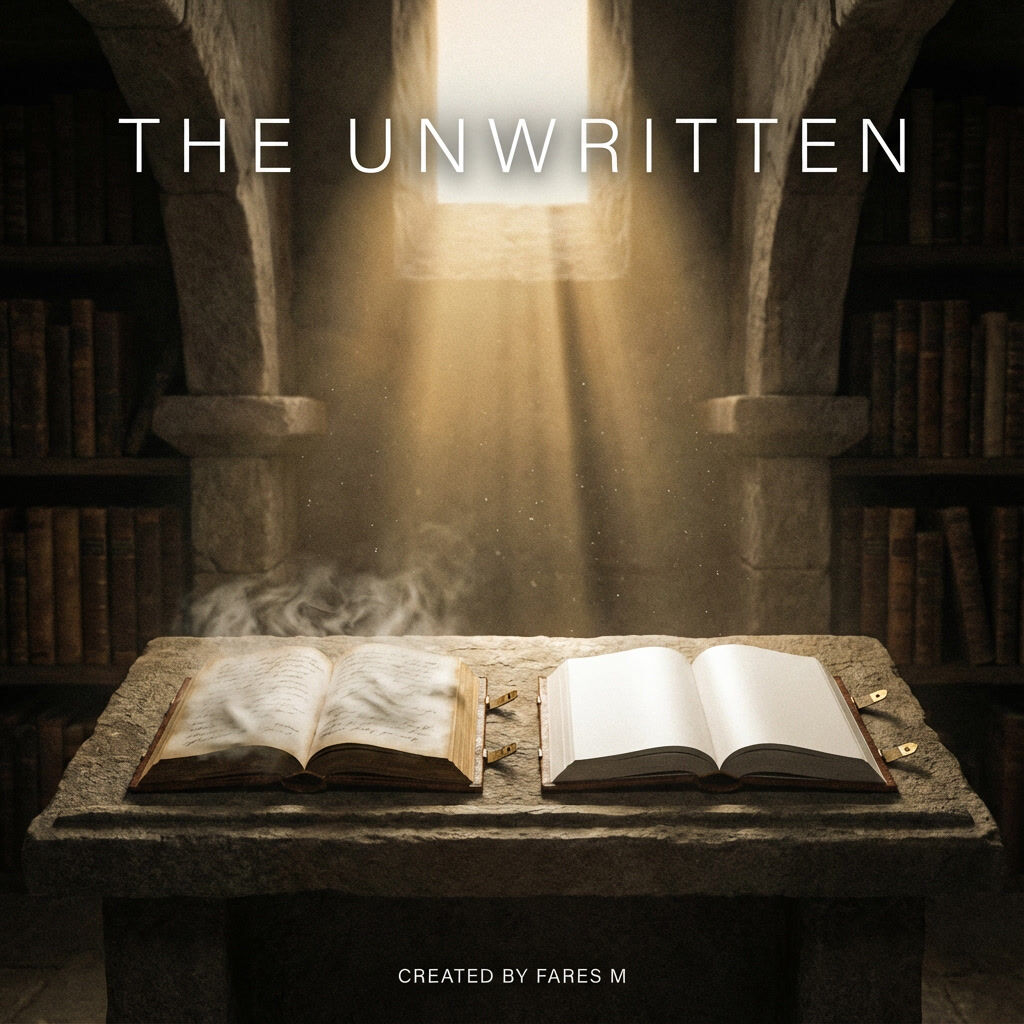
THE UNWRITTEN (TV SERIES / SHOW.")
By Fares Moha
When a guardian discovers newborn twins whose Books of Life are completely blank in a world where tomorrow is always written, he must hide them from a society built on fate, because if those white pages mean they can write their own future, they’ll become the most hunted “key” in the world.
“DARK meets Silo, with the existential mystery of The Leftovers.”
SYNOPSIS:
The Cosmogonic Library
User Manual, Doctrine and Warnings
— Extract from the "Citizen's Guide," Chapter 1: On the Book of Life —
I. The First Principle: The Book at First BreathAt the exact moment a child takes their first breath, something happens simultaneously and without witness: a volume appears in the Cosmogonic Library of the sector.
This volume is the Book of Life (Liber Vitae).
It isn't born from human hands. It isn't manufactured, printed, or assembled. It is given.
The Book is divine in its origin, but it isn't an object of spectacle. It doesn't emit light, doesn't speak, doesn't heal, doesn't protect. It does one thing, and it does it perfectly: it contains the entirety of a life's unfolding, from first breath to last.
What's inscribed there isn't an opinion, a hypothesis, or a probable path. It's the coming unfolding, as the universe has fixed it.
The Book doesn't guess. The Book knows. And what it knows, the world accomplishes.
II. The Unalterable: What No Hand Can DoThe Book cannot be destroyed.
Neither fire, water, blade, acid, pressure, nor time can touch it. It doesn't burn. It doesn't tear. It doesn't stain. It doesn't age. It doesn't absorb traces of the world. Every attempt to mark it fails, like the material refuses to remember.
All Books look the same. Same binding. Same weight. Same texture. Same silence.
The Book bears no clear name, no number, no distinguishing mark. Its identity isn't printed: it's linked.
As long as the being lives, the Book remains. At death, it disappears—no ash, no relic, no proof.
III. The Vital Nexus: The Signature of ExistenceEach human being possesses a unique signature recognized by the Library: the Vital Nexus (VN).
The Vital Nexus isn't an object, a paper, or an engraved number. It's an imprint of existence: a seal that the Library recognizes and that the world doesn't counterfeit.
Thus the Library doesn't "manufacture" the Book: it receives it and reassigns it according to the Law.
IV. The Act of Delivery: Birth ProcedureIn the days following a birth, parents or legal guardians present themselves at the Library of their sector.
The procedure is simple and solemn:
- birth declaration before the Clerk
- verification of guardianship bond (witnesses, seals, oaths)
- recognition of the child's Vital Nexus according to Library rites
- delivery of the Book of Life
This act is recorded in the official register. It is also, by custom and in accordance with long-standing practice, treated as sacred. Because receiving the Book isn't receiving property: it's receiving a charge. You're not being given a rare object. You're being entrusted with the link.
V. The Law of Readability: Who Can ReadA fundamental law governs the Book: it's only readable by its recognized owner.
For any other person, even the closest, the pages become fog, an alphabet without key, an evidence that refuses itself. It's a primary protection, inscribed in the very order of the world.
The Guardianship Period (0–8 years)Until the 8th birthday, the Law grants an exception: guardianship.
During this period, parents or legal guardians can read the child's Book. This exists for a simple reason: to protect the small life in its first years, guide care, prevent perils, understand the days when the child cannot.
The Eight-Year Reassignment (The Closure)On the exact day the child turns eight, the Law changes by itself, without debate and without recourse.
From that moment:
- the Book becomes exclusively readable by the child
- and it becomes exclusively possessable by the child
Parents can no longer keep it, store it "for safety," file it, or monitor it. The Book leaves the guardians' hands and returns to the owner.
Legal guardians have the obligation to return it. Non-compliance carries penalties under Section IV of the Guardianship Code.
This is called the Closure: the future leaves the house. it enters the person.
VI. The Veil of the Future: One Page Per DayThe Book contains the whole life. Yet it doesn't give it.
An inexorable law governs access: the Veil of the Future.
Each morning, at dawn, a single page becomes readable: that of the next 24 hours.
No more.
You will know your day. You will not know your tomorrow. The rest is present in the volume but refuses intelligibility, as if the human mind has no right to more.
The future exists in the Book. But knowledge of the future doesn't exist in man.
VII. The Day's Page: The Unfolding of the Next 24 HoursThe day's page describes the main unfolding of what will happen in the next 24 hours:
- major events
- decisive encounters
- decisions to make
- losses and gains
- accidents, ruptures, revelations
The style is generally neutral, factual, sometimes cold. The Book doesn't explain. It doesn't justify. It doesn't console. It writes.
VIII. The Law of Inevitability: You Cannot Thwart the PageWhat is readable today happens today.
Trying to avoid a written event doesn't cancel it. It just shifts the paths, recomposes the circumstances, and brings the unfolding back to the fixed point.
You can change routes, cancel an appointment, flee a place, break a plan. And yet, the arc of the page recomposes itself until accomplishment.
The day's page isn't a warning. It's a march.
Adaptive DetailsThe Book fixes the essential of the unfolding. Some execution details can vary—the exact time, a route, a setting, an extra—as long as the written arc is strictly realized. This margin isn't an escape. It's how the world breathes without contradicting the inevitable.
IX. Advantages and Disadvantages AdvantagesThe Book reduces the unknown of daily life:
- prepare a day without assumptions
- organize care, safety, travel
- face certain losses with less panic
- live with an order, even harsh, rather than total chaos
The Book imposes a weight:
- mental fatigue: reading what must come and moving forward anyway
- temptation of resignation: "what's the point?"
- social fear: everyone believes the other "knows" something
- indirect manipulation: they don't read your Book, but they watch your reactions after reading
There are births where no Book appears.
They're called the Bookless.
Archives show frequent correlation (not absolute) with certain birth blindnesses, certain major disabilities, certain serious and early illnesses. The Libraries promise nothing and don't explain: there's no procedure to "demand" an absent Book. If the Book didn't appear at first breath, it won't come.
Many claim: "it's a favor." As if life spared some the burden of the page.
But the Bookless often say the opposite: because living without a Book, in a civilization organized around the Book, is living without framework.
- no day's page
- no daily certainty
- no proof of arc
- no common language with those who "read"
Those who have a Book sometimes envy the silence. Those who don't have one envy the page.
XI. The Transaction of Future: The Legal ExchangeEven if you can't read another's Book, there's a recognized act: the legal exchange.
Two consenting adults present themselves at the Library:
- mandatory reflection period (minimum fourteen days)
- conscience interviews
- oaths, seals, deed of cession
- reassignment of Vital Nexuses in the Library registers
The past doesn't change. Memories remain. Actions remain. Bonds already woven remain. This isn't about rewriting the world.
What changes is the readable future: from that day forward, each receives—page after page—the unfolding inscribed in the other Book. And this remains coherent with doctrine, because the Book already contained, since always, the existence of this exchange.
The exchange doesn't invent a destiny. It accomplishes a destiny that contained the exchange.
XII. Rumors of Substitution: Invisibility and DenialThey say there are clandestine substitutions. The Library denies them. Not because it would be naive, but because its structure makes proof almost impossible:
- all Books are strictly identical
- no Book can be marked
- readability is personal
- and if the Vital Nexus "confirms" ownership, then everything is deemed compliant
Thus, a victim can continue to read a valid page, live an inevitable unfolding, and have no opposable proof to claim they're holding another Book.
When the world accomplishes what you read, how do you prove it wasn't yours?
(Explanatory note,"The Theft / the clandestine exchange," as reported by rumors: the Book itself cannot be falsified, modified, or copied. The only possible flaw doesn't concern the object, but the link. Corrupt employees, hands in the registers, displaced seals, betrayed oaths, wouldn't need to fabricate a fake Book: they'd simply need to swap the attribution of Vital Nexuses in internal archives. Then, they remove the victim's Book and replace it with another, and since all Books look exactly the same, the substitution triggers no material suspicion. The victim notices nothing: in the morning, a page becomes readable, the unfolding is inevitable, and they believe they're reading "their" future when they're now reading that of a stranger. If the page announces ruin, illness, social fall, the victim accepts it as if it were their original trajectory. The usurper walks in a life that wasn't theirs. And when the victim tries to complain, the Library opposes the same answer: absolute security, compliant register, absence of proof, because no one, institution included, can read a Book in place of the owner. Thus, the very idea of a clandestine exchange becomes a fable in the eyes of the system.)
XIII. Essential WarningsRemember this:
Your Book is linked to your life. As long as you live, it remains. At your death, it disappears.
The Book isn't a weapon. Reading isn't changing.
The day's page is inevitable. The only recognized freedom is the manner of crossing it.
At eight years old, the Book returns to its owner. Keeping it is impossible. Holding onto it is useless.
Beware of overly advantageous stories. The price to pay isn't in money.
— Citizen's Guide, Central Cosmogonic Library
I. BIRTH: SILAS & NOEMADawn hadn't arrived yet.
In ARTOS's house, light came through cracks in the wood. You could hear the world breathing outside: a dog somewhere far off, footsteps in the dust, the quiet rustling of a tree.
ARTOS was already awake.
Had been for hours, maybe. He'd lost track. He stared at the Book in front of him like you stare at a courthouse you can't run from, even when running is all you want to do.
He'd been putting it off.
Not out of courage. Out of instinct. Because some mornings, you just know the page is going to take something from you that you'll never get back.
He put his hand on the cover without opening it right away. The material didn't age. Didn't stain. It had a faint smell, like old wax left too long in a drawer, not unpleasant, just there.
He breathed in.
Then he opened it.
The day's page became readable.
His eyes moved quickly at first, mechanically, trying to catch the essentials, until the words caught him instead.
He read it again, slower this time. The room felt smaller.
The page said CRISTAL would die today.
It said it without hesitation, without softening it, without detour, the way you'd write "the sun will rise."
The page also said what he already knew, what his nights had been whispering for weeks: there would be two of them. Twins.
And it said what his shame had always known before his head did:
he wouldn't raise them.
Not "he couldn't." Not "he wouldn't want to."
He wouldn't raise them.
As if running away was part of the same block of truth as death and birth.
ARTOS sat still for a long time. Hands flat on the table. Eyes on the page. Breathing shallow, like the Book was stealing his air.
He thought about Cristal. About her round belly. About the way she'd rest her hand on it and smile, like life was a promise and not a debt.
He thought about the twins. Two little mouths, two cries, two futures already written.
And he thought about himself.
About what he was: a man who'd loved his freedom too much to learn how to love a burden.
He closed the Book.
He stood up.
He took a coat. A bag. A few coins. Nothing more.
No letter. No goodbye.
He crossed the house without a sound, like a thief in his own life. The floorboards creaked once under his heel—he froze, listened, then kept moving. He opened the door.
And in the cold morning air, he chose the only thing he knew how to do: disappear.
For a breath, he almost turned back. Then the Book's line came back to him—he wouldn't raise them—and he didn't.
ARTOS left the village the morning of the birth, because his Book had told him everything—his wife's death, the twins, and his cowardice, and because he'd rather become a shadow than a father.
Night fell.
A real night: thick, slow, without promise.
In a stone house with closed shutters, they'd pulled out clean sheets, heated water, prepared cloth. A midwife had laid out her herbs, her thread, her sure hands. Women from the neighborhood had gathered, not to change destiny—no one could do that, but to keep the silence from winning too fast.
CRISTAL was gasping, soaked in sweat, face pale, eyes wide open. Sometimes she stared at the ceiling like she was reading her own page, even without a Book.
The midwife murmured old words. Not prayers to prevent anything—there was no preventing. Words to hold on.
Then the pain broke into a scream.
And life arrived.
Two cries rang out almost at the same time.
Twins.
They barely laid them on her: two red faces, two mouths open to the world, two breaths trembling in the air.
And somewhere in the Cosmogonic Library of the sector, two volumes appeared at the exact same moment.
CRISTAL smiled.
For one second. Just one.
Then her gaze emptied out, like the light had withdrawn from her the moment she gave it away.
The midwife understood before the others. The women around her understood after. Someone put a hand on a forehead. Searched for a heartbeat. Couldn't find it anymore.
Cristal had just died at their birth.
And ARTOS was already nothing but an absence.
In the shadow of the doorway, a man had been waiting for hours.
ARCHILDE.
People knew him as a friend of the house. But that word didn't say everything.
He'd loved Cristal in silence, not a love of confession, a love of keeping watch. The kind that doesn't ask for anything but stays. The kind that senses worries before they speak.
Archilde was an orphan himself. He knew what abandonment does: it leaves holes you try to fill with habits, with anger, with running.
And he knew what life demands: sometimes it takes everything from you, then asks for more.
Most of all—he knew this night was coming.
Because his Book had written it for him. Not once, not clearly, but day after day, guiding him toward a specific point. He'd moved through it like you move toward a door you're afraid to open.
When the news came, Cristal dead, Artos gone—Archilde wasn't surprised. He was broken.
But he didn't collapse.
The day after the funeral, he walked into the Office of Guardianship like you walk into a cage you're accepting.
He asked to become the legal guardian of the two children.
They watched him. They questioned him. They brought in witnesses. They consulted the elders. They weighed his solitude against the children's.
The mother's death, the father's flight: it was all there, dry, implacable.
Then they sealed it.
Archilde became the guardian.
And according to the Law, he had to do what all guardians do after a birth: go to the Library.
The Cosmogonic Library of the sector wasn't a palace, but everything about it demanded silence. People spoke quietly. Footsteps seemed muffled. Even the air held back, like the walls were listening.
Archilde entered with the newborns wrapped against him.
The Clerk barely looked up. He didn't need to.
"The Vital Nexuses."
Archilde presented the guardianship seals, the birth declaration, the proofs the world requires to recognize a bond.
The Clerk placed his hand above the children's foreheads without touching them and spoke the standard formula—the same one for generations. Then he consulted a thick register whose pages never yellowed.
He turned toward a closed alcove.
And he brought out two identical volumes, heavy, intact, like they'd always been there.
He set them on the counter.
Two Books of Life.
One for SILAS. One for NOEMA.
Archilde took them with strange care. He felt the weight, not just of the material, but of what those pages already contained. A whole life, already written. Everything, already fixed.
He left the Library without a word.
Life went on.
The next morning, at dawn, Archilde sat at his table.
He opened his own Book.
The day's page became readable.
And the blood left his face.
Because in the dry neutrality of the lines, there was a sentence. A sentence that had no place in the order of the world.
"Today, you will discover that the children's Books are blank."
Archilde read it again. Once. Then a second time. Like the Book was going to correct itself.
He closed it.
And he went to check.
Until they turned eight, he had the right: the Law granted him reading under guardianship.
He took Silas's Book first.
He opened it.
The page was blank. Not blurry. Not unreadable. Just blank, virgin, absolute, like the ink had forgotten to be born.
He turned the page.
Blank.
He turned again.
Still blank.
Heart tight, he took Noema's Book.
Same thing.
Perfect pages. New. Blank.
Two Books of Life... with no life written.
An anomaly.
No.
An impossibility.
Archilde felt a cold rising up his neck.
In this world, everyone knew about the Bookless. Those who were born without a volume, and who people said, rightly or wrongly that life was doing them a favor.
But this wasn't that.
Silas and Noema had a Book.
Indestructible.
Identical to all the others.
And yet... empty.
A shiver older than reason went through Archilde. A memory of rumor, a phrase he'd heard once from an old man: half drunk, half prophet.
A legend.
They said that one day, children would be born with a blank Book. Not absent. Not Bookless. Different.
Children whose Book wouldn't contain a fixed unfolding.
Children capable of writing their own story.
They called them... the Chosen.
Archilde had always filed that away with fairy tales. Stories that comfort the poor and make the wise laugh.
But now, two blank volumes erased his certainty.
And in a world where destiny gets sold, stolen, traded, falsified in silence...
...two blank Books weren't a blessing.
They were a target.
A danger capable of swallowing an entire city.
Archilde slowly closed both Books, like you close a door on a fire.
Then he understood, with brutal clarity:
he had to keep the secret.
Against the Forgers.
Against rumors.
Against theft.
Against clandestine exchange.
And maybe... against his own page tomorrow.
Hand trembling, Archilde searched for a quill and ink.
He knew, like everyone knew, that you can't write on a Book of Life. Kings have tried, scholars have tried, desperate people have tried: the ink doesn't hold, the mark doesn't stay, the world refuses the trace.
But the legend of the Chosen said something else.
It said: "Their Book is blank because it awaits their hand."
So Archilde tried.
He opened Silas's Book to a blank page.
He wrote slowly, almost holding his breath:
"Today, Silas will laugh."
Nothing stayed.
The ink didn't dry. It didn't spread. It disappeared, swallowed by the white, like the page was drinking the night to make the day emptier. The ink smelled sour, like it had sat too long in the bottle.
He tried again. One word. A date. A sign.
Still nothing.
He moved to Noema's Book.
Same refusal. Same untouched white.
Then a conclusion fell into him, heavy and clear:
if the legend was true...
it wasn't him who had to write.
It was them.
The only ones, maybe, who could inscribe something on those pages. The only ones who could prove, or break—the legend.
And if these children were a key...
he was preparing them for the worst.
Just to clarify: this is only a draft.
What I’m really seeing is a series with a fully built universe—something you can expand in multiple directions, with different arcs, characters, and storylines branching out over time.
With the right development, it has the potential to become a high-value franchise, not just a one-off story.
THE UNWRITTEN (TV SERIES / SHOW.")
View screenplay Register / Log In

Rated this logline
Rated this logline
Rated this logline
Rated this logline