THE STAGE 32 LOGLINES
Post your loglines. Get and give feedback.

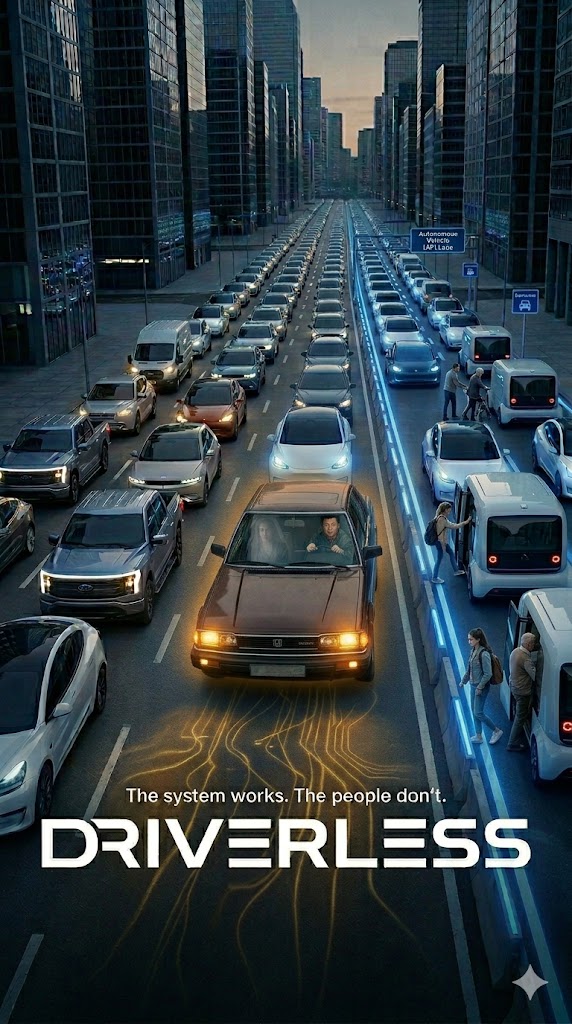
DRIVERLESS
By Joseph Murkijanian
In a near-future city run by autonomous cars, a group of displaced drivers secretly hack the system to reclaim their livelihoods—but when their disruption spirals into a life-threatening crisis, a father and daughter must decide how far they’re willing to go to fight a machine that can’t feel the damage it causes.
SYNOPSIS:
In the near future, city streets move with flawless precision. Autonomous vehicles—sleek, silent, and perfectly optimized—have replaced human drivers almost entirely. The system works. It’s efficient, safe, and indifferent. And for the thousands of immigrant drivers who once powered the city’s rideshare economy, it’s a slow extinction.
ARMIN KARIMI, a 58-year-old driver who has spent three decades behind the wheel, refuses to disappear quietly. He still picks up passengers the old way—talking, listening, connecting—offering something the machines can’t replicate. But as demand collapses and his earnings dwindle, Armin watches his livelihood—and identity—slip away.
Desperate, he gathers a small group of fellow displaced drivers: men and women from different cultures, bound by the same fear of being erased. Their solution is unconventional—and risky. They turn to their children, a younger generation fluent in code and systems, to help them fight back.
Among them is LENA, Armin’s daughter, a sharp, disciplined product manager working inside the very tech ecosystem that is replacing him. Reluctantly pulled into her father’s world, Lena joins a group of young programmers who discover a subtle vulnerability in the autonomous network: by injecting false traffic data into public systems, they can manipulate routing patterns—creating small windows where human drivers regain control.
At first, it works. The drivers reclaim rides. Income returns. More importantly, something human re-enters the system—conversations, connection, presence. Passengers who once rode in silence begin to rediscover what it means to be seen. For a brief moment, it feels like balance has been restored.
But the system adapts.
As the group escalates their interference—pushing into more aggressive tactics to stay ahead—the consequences become harder to control. What began as a quiet protest turns into a dangerous game with a network that governs an entire city. When a rogue deployment triggers a routing failure that delays an ambulance carrying a child in critical condition, the illusion of harmless disruption collapses.
The cost is no longer abstract.
Faced with the real-world consequences of their actions, Lena must make an impossible choice: protect her father and his community—or take responsibility for what they’ve unleashed. As corporate investigators close in and the system begins to trace the anomalies back to their source, Lena steps forward with a voluntary confession, risking her career to shield the drivers from greater harm.
In the aftermath, no one walks away unchanged. The drivers return to the margins, but not invisibly. The system remains—but it’s been challenged, questioned, forced to acknowledge what it lacks. And Armin, for the first time, learns to listen instead of speak—accepting his daughter not as someone to protect, but as someone who has already carried more than he ever understood.
In a world moving toward perfect automation, DRIVERLESS asks a simple question:
If a machine can take you anywhere you want to go…
Who takes you where you need to go?
 Register / Log In

Rated this logline
Rated this logline